I’ll start with a caveat: I’m still learning about this stuff.
I work in marketing at Rocketspark, so I spend a lot of time around websites, search and the businesses and designers trying to make sense of how AI is changing both.

I'm seeing the questions come up more often: Should I be creating more content with AI? Will 50 pages help me get found? What do I need to do to show up in ChatGPT?
I’ve been trying to get my head around it through what we see with our customers and design partners, what we’re working on in the marketing team, what really experienced search people are finding and what Google itself is saying.
Just quietly (here I am saying this in a public post though), I’m also becoming a little sceptical of the growing number of AI search “experts” with a definitive playbook. We already seem to be entering the ‘one weird trick to get ChatGPT to recommend your business’ phase.
Maybe some of those tricks work. But this whole space is moving incredibly quickly, so I’m more interested in the things that will still make sense when the hacks change.
The tl;dr of what I’ve learned is:
AI has made producing content incredibly easy. It hasn’t made having something useful that stands out any easier. You need a human, I reckon.

Google doesn’t have a problem with AI
Like most things, Google is a good place to start. And this is something I was keen to understand for the sake of our own marketing work.
Using AI doesn’t automatically hurt your search engine optimisation (SEO), which is simply the work you do to help your website get found on Google and other search engines.
Ahrefs, a company that analyses a huge amount of search data, studied 331,000 webpages in July 2026.
It found plenty of pages written almost entirely by AI ranking highly in Google. In fact, 5.3% of pages ranking in positions one to three were tagged as being AI-generated.
But it also found that heavily AI-written pages were less likely to make it into Google’s searchable database and generally got fewer search impressions than pages with less AI content.
Semrush found something similar.
It analysed 42,000 blog posts and found that content tagged as human-written appeared in Google’s number one position 80% of the time, compared with 9% for content tagged as purely AI-generated. In other words, the number one result was about eight times more likely to be classified as human-written.
That doesn’t prove Google is sitting there detecting AI and marking it down. AI detection itself is imperfect and there are all sorts of other factors involved in why a page ranks.
Google itself says generative AI can be useful for researching a topic and structuring original content. Its warning is about using AI to generate lots of pages without adding value for people.
So I don’t think the most useful question is:
“Did AI write this?”
I think it’s:
“Does this page/blog/content deserve to exist?”
Let’s E-E-A-T!
Google has an acronym that I think is actually pretty useful here: E-E-A-T.
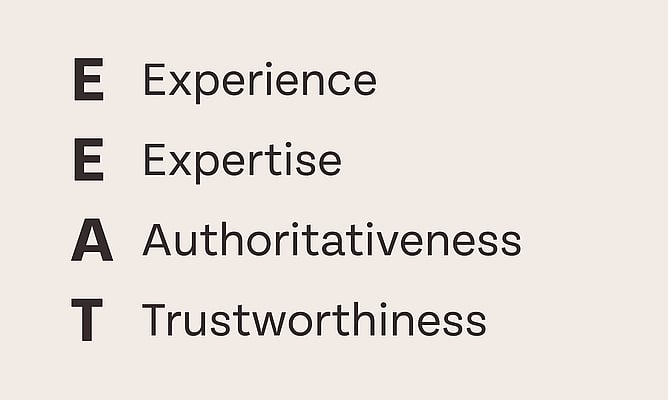
It stands for Experience, Expertise, Authoritativeness and Trustworthiness.
It’s not a Google ranking score you can optimise your way to 87/100. It’s part of the framework Google uses in its search quality guidelines, and I think it’s a pretty useful lens for website content even if you don’t care about Google.
Experience: Have you actually done the thing you’re talking about?
Expertise: Do you know your stuff?
Authoritativeness: Is there evidence that people should take you seriously?
Trustworthiness: Can someone believe what they’re reading?
The first E, Experience, seems like the one I’d focus on first.
Google added it to the framework in 2022, specifically calling out the value of first-hand knowledge. Things like actually using a product, visiting a place or communicating something you personally experienced.
That feels particularly important now with so much AI slop out there all saying roughly the same thing.
AI can explain when you might need to rewire an old house.
It hasn’t worked on hundreds of old Wellington villas and learned the little warning signs that tell you what’s hiding behind the walls.
It can produce “10 tips for choosing an accountant”.
AI hasn’t spent years talking to real business owners in your local area and noticed the same problem coming up again and again.
That’s your advantage.
I reckon a useful rule to come back to at the end of producing something, whether AI was involved or not, is this:
If AI could write the entire page without needing to talk to anyone in your business, the page probably needs more of you.
Try this on your own content
AI can’t invent that experience for you. But it can be really useful for helping you find it, draw it out and get it onto the page.
Paste one of your pages or blog posts into ChatGPT and try this:
The point isn’t to ask AI to make you sound more experienced. It’s to use AI to help get the actual experience out of your head and onto the page.
The hard part isn’t really writing anymore
Ahrefs published something earlier this year that really clicked for me.
One of its writers used AI to create 40 articles and came away thinking that AI had made the writing much faster, but writing was never really the hard part.
The hard part was the information: useful ideas, verified facts and source material worth trusting.
We see a version of this around websites at Rocketspark.
The businesses we work with generally aren’t short of knowledge. Often the problem is getting it out of someone’s head and onto the website in a way a customer can understand.
The good stuff is already there.
The goodness is in the questions customers ask every week, the photos on someone’s phone, the job that went particularly well, the job that didn’t, the opinions they’ve formed and the slightly obscure things they know after doing something for 15 years.
That’s 100% what I’d feed AI (or just put pen to paper!).
Before creating another page, I’d ask:
Does this answer something a real customer actually asks?
What do we know about this that other businesses like us might not?
Can we show a real example, photo, result or customer story?
Would I happily send this page to a customer?
If we removed it tomorrow, would anyone miss it?
That feels more useful to me than setting a target of 50 or 100 pages.
Since I’ve just yarned about the first E in E-E-A-T, here’s a practical example from our own experience.
Atlas Digital, who help us with search, recently got us to remove or consolidate a bunch of low-volume pages. The content wasn’t bad (we think!), but it just wasn’t doing enough to justify using our crawl budget (basically, the amount of time and resources Google is willing to spend crawling your site).
We’ve seen what happens when pumping out loads of content becomes the strategy
There’s an example from 2023 that regularly comes up when people talk about the risks of publishing a heap of AI content: the Causal “SEO heist”.
Around 1,800 low-quality AI-generated articles were published. Traffic initially took off. Then Google applied a penalty.
A later Ahrefs analysis estimated that Causal’s organic Google traffic had fallen by 99.52%, from more than 300,000 estimated monthly visits to fewer than 1,500 🤯
I wouldn’t take an example from 2023 as proof that today’s much better AI content can’t work.
The more interesting lesson is the temptation to find something that works and scale it until it stops working.
Google is still pretty explicit about this in 2026. Generating large numbers of pages primarily to manipulate search rankings or generative AI responses can violate its scaled content abuse policy. It also says that simply creating more pages doesn’t make a site higher quality or more useful.
The problem isn’t really scale itself. It’s when scale becomes the strategy.
I’m sceptical of AI search hacks too
The next frontier, of course, is getting mentioned by ChatGPT and other AI tools.
Again, I’m learning.
But I’m wary of treating this as another system where we just need to discover the right hacks. That kind of short term thinking could backfire.
Interestingly, Google said in May 2026 that its existing SEO best practices remain foundational for appearing in its generative AI search features, while specifically highlighting the importance of valuable, unique content.
There’s a useful real-world example too.
Search consultant Glenn Gabe looked at a website that had created more than 850,000 AI-generated local news pages.
Google applied a manual action for what it calls “scaled content abuse” and removed that section of the website from its index.
Gabe then checked ChatGPT prompts where those pages had previously appeared as sources. Most of the citations he tested had disappeared there too.
Obviously, 850,000 pages bears almost no resemblance to a normal small business website.
But the principle makes sense to me:
Rather than trying to game Google or ChatGPT, make your website worth using as a source.
The rules can change quickly. Ryan McMillan from Atlas Digital (our Digital Marketing Agency) recently shared a good example. Reddit had become a pretty common source in ChatGPT answers, then its citations dropped sharply almost overnight.
Where I think AI genuinely helps
I think AI is genuinely useful when it supports the human part rather than replacing it.
We’ve built AI into Rocketspark ourselves. Our AI assistant, Flint, helps people plan pages, structure their thoughts and get past the blank-page problem.
The important bit is still what the business puts into it.
Give AI your customer questions, project notes, photos, opinions and the lessons you’ve learned the hard way.
Then let it help you research, organise, draft and edit.
I think there’s an opportunity here for freelance designers too.
If anyone can generate 100 generic pages in a few minutes, “more content” isn’t much of a value proposition.
The valuable skill is drawing out what makes a client credible, interesting and different, then turning that into something their customers can understand and trust.
That probably means asking better questions.
What do customers always misunderstand?
What do you do differently from other businesses?
What have you changed your mind about after doing this for ten years?
Show me the last job you were really proud of.
What went wrong on this one?
What do you wish customers knew before they called you?
There’s a lot of good website content hiding in the answers to questions like those.
I’m sure my thinking on all of this will continue to change. AI search is moving quickly and I don’t think anyone has it completely figured out.
But this is the bit I feel pretty comfortable with.
Use AI. Just don’t outsource the interesting, fun, human, creative parts.
Your website doesn’t need more content just because producing it is now easy. It needs more of you.
How I made this article (yes, I did use AI)
AI was involved throughout this article. I used ChatGPT and my good friend Claude to help research and find sources, interview me about my thinking, draft and challenge.
Then I spent a couple of hours refining it, rewriting, re-reading the research and checking the claims. I learnt heaps and I definitely stand by all the words in this article.
Interestingly, Ahrefs makes the same point in this piece on how they use AI without making slop:
“The important question is not how many or what kind of words AI wrote. It is whether a human understood, judged, verified, and stood behind what went live.”
Hopefully I’ve done enough of that to justify your attention.